
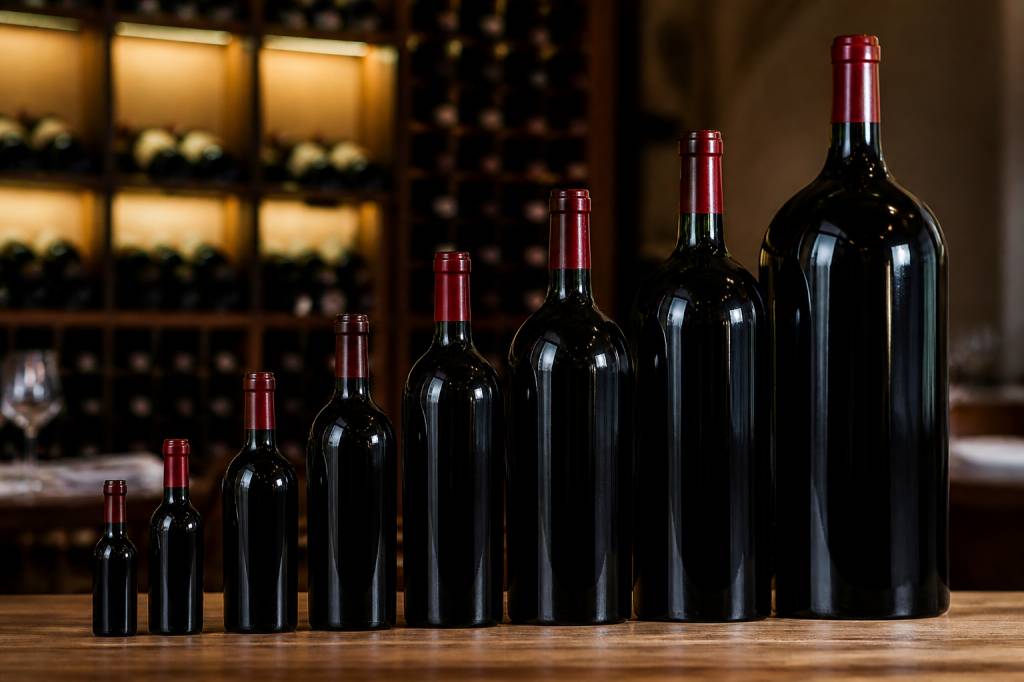
For most collectors, the first big decision is not which vineyard to chase or which vintage to hunt down. It is bottle size. And once you leave the standard 750 ml format, things become more interesting very quickly. Large-format bottles are not just theatrical objects for a dining room or auction catalogue. They have practical implications for ageing, service, storage, and even the way a wine tastes over time.
If you have ever wondered whether a magnum is genuinely better than two standard bottles, or whether that intimidating Nebuchadnezzar is anything more than a party trick, the short answer is yes, often. The longer answer is where collectors and serious drinkers should pay attention. Bottle size influences oxygen exchange, wine evolution, presentation, and value. In other words: it matters, and quite a lot.
What counts as a very large bottle?
Wine bottle formats beyond the standard bottle are usually named after biblical kings and historical rulers, which is useful if you enjoy your cellar with a side of drama. The most common large formats are:
Beyond that, you enter the territory of custom and spectacle. Some producers release oversized formats only for special vintages, auction lots, or institutional cellars. These bottles are rare, expensive to produce, and difficult to handle. That is exactly why collectors love them.
Why large formats age differently
The core advantage of a large bottle is simple: the ratio of wine to oxygen is more favourable. A larger volume of wine in relation to the small amount of oxygen trapped in the neck means slower evolution. This is not folklore. It is one of the most accepted practical principles in wine ageing.
In a magnum, the wine generally develops more slowly and often more gracefully than in a standard bottle of the same wine and vintage. That does not mean “better” in every case, but it does mean more controlled maturation. Aromatics tend to stay fresher for longer, tannins can integrate with more precision, and the wine often shows a longer drinking window.
For collectors, this matters because a magnum can preserve the energy of a great vintage while allowing tertiary complexity to emerge at a more measured pace. For wines that benefit from ageing — structured Bordeaux, top Nebbiolo, serious Rioja, ageworthy Champagne — large formats can be the difference between a wine that peaks too early and one that unfolds over decades.
There is one caveat, and it is important: large format does not magically improve mediocre wine. If the original wine lacks concentration, balance, or acidity, the bottle size will not rescue it. A bigger bottle simply gives a good wine better conditions to evolve. It does not perform miracles. The market would love you to believe otherwise.
Which styles benefit most from large bottles?
Not every wine deserves a giant bottle. Some styles are built for early enjoyment, and placing them in a 9 L bottle is mostly an exercise in ego. The best candidates are wines with structure, acidity, and a strong ageing track record.
By contrast, delicate wines with lower acidity or fragile aromatics may not gain much from oversized formats. Very aromatic whites can be delicious in magnum, but beyond that, the utility becomes more case-specific. The rule is straightforward: if a wine ages well in standard bottle, it will likely age well — and often better — in large format.
Collector value: rarity, prestige, and market logic
Collectors are drawn to large bottles for more than cellar chemistry. There is scarcity, visual impact, and a measurable market premium for certain formats. A magnum from a top château or grower Champagne house can be noticeably more sought-after than two regular bottles, even when the liquid inside is identical. Why? Because the supply is lower and the demand is often higher among serious buyers.
At auction, large formats tend to command attention. They photograph well, they serve as centrepieces, and they signal a certain level of commitment. A magnum in a cellar suggests intent. A Salmanazar suggests either deep enthusiasm or access to a very sturdy shelving system.
Still, the collector should remain rational. Premiums vary widely by producer, region, vintage, and market timing. A large format from a respected estate may appreciate faster than a standard bottle, but not always. The strongest drivers of value remain the usual suspects: producer reputation, vintage quality, provenance, condition, and storage history.
One practical point often ignored by new collectors: if you plan to buy large formats for investment, focus on wines with an active secondary market and a strong track record in mature vintages. Buying a spectacular bottle size simply because it looks impressive is a fast way to acquire expensive shelf décor.
Storage: where the romance meets logistics
Large bottles are beautiful, but they are not convenient. That is precisely why storage deserves serious attention. A 1.5 L magnum is manageable. A 6 L methuselah is already awkward. At 15 or 18 L, handling becomes a two-person operation, and sometimes a three-person one if you value your back.
The main storage principles are the same as for standard bottles:
The problem is physical space. Large bottles do not fit standard racks. You need reinforced shelving, custom cradles, or purpose-built storage. If a bottle is unusually tall or wide, make sure your cellar dimensions actually accommodate it before purchase. This sounds obvious, but many collectors discover too late that their prized jeroboam cannot be stored upright without an awkward compromise.
There is also the issue of sediment. Older large-format reds should be handled carefully before service, just like standard bottles. In fact, their size can make decanting more complex because the weight and neck angle are less forgiving. If you intend to serve an aged large-format wine, plan the logistics well in advance.
Service and opening: ceremony with method
Opening a very large bottle is part theatre, part technical exercise. The cork may be larger, tighter, or simply more difficult to extract cleanly. For sparkling wine, the pressure and format together demand control. For still wine, pouring from a heavy vessel is not exactly graceful unless you have practiced.
Useful considerations include:
One practical tip from the field: the larger the bottle, the more time you need to let the wine settle after transport. A magnum shipped yesterday and opened tonight is one thing; a 12 L bottle moved across a room, then popped immediately, is another. Give the wine time to recover from handling, especially if it has travelled.
When to choose a large bottle
Large-format wine is most rewarding when the occasion justifies it. Ask yourself a simple question: do you want a bottle, or do you want a shared experience?
For birthdays, weddings, anniversaries, cellar tastings, milestone dinners, and group celebrations, large bottles make excellent sense. They create a focal point and improve pacing because a single bottle can serve more people. They also tend to encourage slower, more attentive drinking. That is rarely a bad thing.
They are particularly effective when paired with occasions where the wine itself should be part of the memory. A magnum of mature Champagne at a wedding dinner, or a double magnum of Bordeaux at a reunion, does more than feed guests. It anchors the event in taste, texture, and ritual.
For collectors, some large formats also make sense as long-term cellar projects. A great vintage in magnum can be opened a decade or more after its standard-bottle counterpart and still show remarkable freshness. That creates useful flexibility: you can drink the standard bottles earlier and keep the magnums for later milestones.
Buying tips that actually matter
Buying large-format bottles requires more discipline than buying standard wine. The stakes are higher, the storage demands are real, and the condition checks matter even more.
If you are buying for immediate celebration, freshness and serviceability matter more than investment logic. If you are buying for the cellar, focus on producers and vintages with known longevity. And if a format seems dramatically underpriced, ask why. There is often a reason.
The practical verdict for collectors
Very large wine bottles are not a gimmick, at least not when they are used intelligently. They offer slower ageing, strong visual impact, and real collector appeal. They can improve the trajectory of serious wines, especially structured reds and high-quality sparkling wine. They also demand more from the owner: more space, more care, more planning, and often more money.
That balance is exactly what makes them interesting. A large bottle is both object and liquid, both storage problem and celebration tool. For the collector, that dual nature is part of the appeal. For the host, it is a way to turn a dinner into a memorable event without resorting to novelty for its own sake.
If you buy large formats with discipline, choose wines that justify them, and store them correctly, they can become some of the most rewarding bottles in your cellar. And when the day comes to open one, the bottle will do half the storytelling before the first glass is poured. Which, in wine terms, is about as elegant as it gets.