


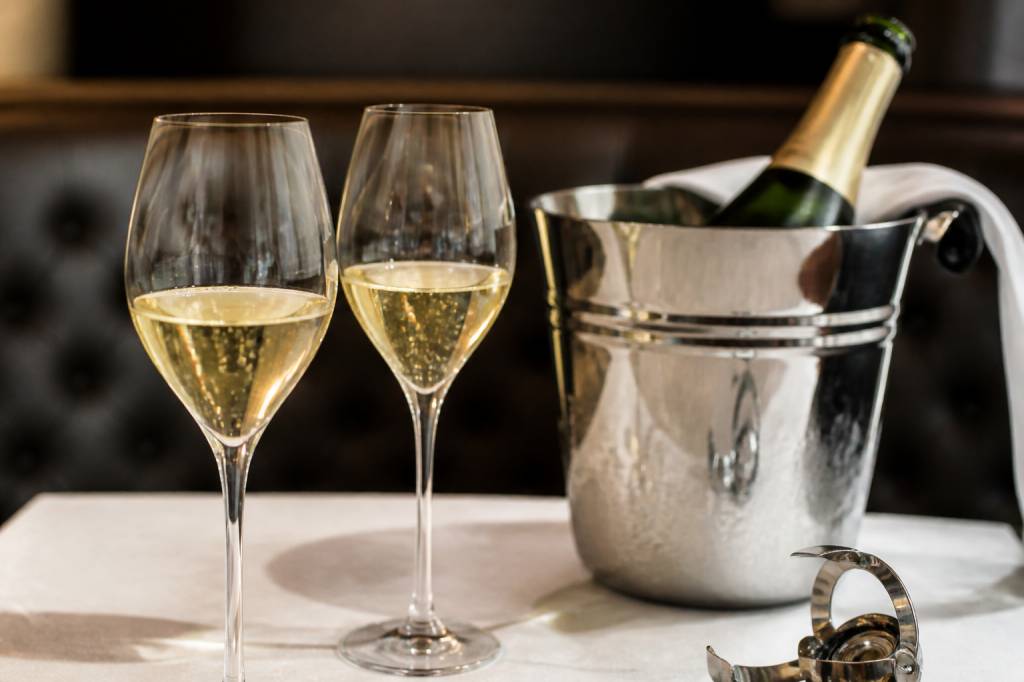
Non-vintage Champagne is one of those categories people drink regularly without necessarily understanding what is in the glass. That is a mistake. NV Champagne is not a lesser version of vintage Champagne, nor is it a stylistic placeholder for “the house couldn’t be bothered to declare a year.” It is, in most cases, the most important expression of a Champagne house’s identity: the blend they repeat, refine, and defend year after year.
If you want to understand Champagne properly, you need to start here. Non-vintage bottlings account for the vast majority of Champagne production, and they are the benchmark against which producers maintain consistency. In a region defined by climate variability, this is not a trivial task. It is an exercise in blending, reserve wine management, and technical discipline. In other words, the opposite of improvisation.
What “non-vintage” actually means
Non-vintage, or NV, Champagne is made from grapes harvested in multiple years rather than from a single declared harvest. That is the basic definition, but it misses the point if left there. The real purpose of NV Champagne is consistency. A house such as Bollinger, Pol Roger, or Louis Roederer aims to produce a cuvée that tastes recognisably itself regardless of the weather that year brought to the vineyards.
Why is this necessary? Because Champagne is a marginal climate. Frost, rain, hail, uneven ripening, and cool autumns are part of the job description. A single harvest can be excellent, good, or frustratingly patchy. Blending across vintages allows producers to balance acidity, maturity, structure, and aromatic profile. One year may bring ripe fruit; another may bring sharper acidity and tension. Put them together intelligently, and you get a wine that is more complete than either component on its own.
It is worth noting that “non-vintage” does not mean “made from inferior fruit.” Quality NV Champagne can include excellent base wines from strong years, retained in reserve to be used later. In practice, the best houses treat reserve wine like a strategic asset. If you have never tasted an NV Champagne that seemed unusually complex for the category, chances are the producer’s reserve wine programme is doing serious work behind the scenes.
How it is made: blending as a technical discipline
Champagne production is already demanding before blending even begins. The grapes are pressed gently, usually to produce cuvées and tailles with different levels of delicacy and extract. Base wines are fermented separately, often by parcel, grape variety, and vineyard site. Then comes the assembling of the final blend, where the house style is either preserved or exposed as a vague marketing slogan.
Most NV Champagnes rely on a combination of the three principal grape varieties of the region:
- Pinot Noir for body, red-fruit character, and structural grip
- Meunier for roundness, early-drinking charm, and softer fruit expression
- Chardonnay for freshness, linearity, citrus notes, and ageing potential
The exact proportions vary wildly depending on the producer. A blanc de blancs NV will lean entirely on Chardonnay, while a more traditional house blend may use Pinot Noir as the backbone. Some producers deliberately increase the proportion of reserve wines to enhance complexity and consistency. Others prefer a fresher, more immediate style with a larger share of current-year base wine. There is no single formula, but there is always a logic.
In many houses, reserve wines are kept in stainless steel, large oak, or even solera-like systems. The method matters because it influences oxidation, texture, and aromatic development. Stainless steel preserves brightness. Oak can introduce spice, breadth, and subtle oxidative nuance. A perpetual reserve system can provide remarkable continuity, though it can also mask the character of a given year if handled too heavily. As always in wine, technique is only brilliant when it is invisible.
What non-vintage Champagne tastes like
Here is the practical answer: NV Champagne usually tastes balanced, fresh, and coherent. But that tells you very little unless you know what to look for. The style depends on the house, the blend, the dosage, and the proportion of reserve wine. Even so, certain patterns recur.
On the nose, expect green apple, lemon peel, citrus blossom, pear, white peach, brioche, fresh almond, and sometimes subtle toast or biscuit. More structured examples may show hazelnut, pastry, chalk, and a faint saline edge. If the producer uses significant reserve wine or oak, you may also find notes of dried fruit, spice, or gentle oxidation.
On the palate, NV Champagne often leads with brisk acidity and a fine mousse. The best examples are not simply “fresh”; they are integrated. The dosage should support the structure without obvious sweetness. If the wine feels thin, the blend is underbuilt. If it feels clumsy or sugary, the balance is off. Good NV Champagne should finish cleanly, with enough persistence to justify the price and enough precision to make another sip inevitable.
Texturally, NV Champagne can vary from razor-sharp and tensile to creamy and broad. This is where style becomes important. A grower Champagne may prioritise vineyard expression and tension, while a major house may aim for polish, depth, and seamlessness. Neither is automatically superior. The question is whether the wine delivers what it promises.
Why it matters more than people think
NV Champagne matters because it is the foundation of the category. Most consumers encounter Champagne first through NV bottlings, not rare vintages. If you judge the region through that lens, you are not seeing a compromised version of Champagne. You are seeing the core of its commercial and stylistic identity.
It also matters because NV Champagne is often the most difficult style to get right. Vintage Champagne benefits from a generous harvest and the prestige of singularity. NV Champagne has no such luxury. It must absorb climatic inconsistency and still taste deliberate. That is a much harder task than simply bottling a strong year and waiting for praise.
There is also a practical reason. NV Champagne is the bottle most likely to be opened for an aperitif, a celebration, or a dinner where the guest list is more important than the label. In other words, it has to perform. A wine that is technically impressive but emotionally flat will fail. A wine that is charming but loose will also fail. The category survives because the best examples manage to be both serious and pleasurable. That is not a small achievement.
From a market perspective, NV Champagne also offers the clearest insight into a producer’s house style. Vintage wines can be shaped heavily by the year. NV wines reveal consistency, blending philosophy, dosage preferences, and ageing regime. If you want to know whether a producer values austerity, richness, freshness, or texture, start with the non-vintage release. It usually tells the truth faster than the marketing brochure.
How it differs from vintage Champagne
The difference between NV and vintage Champagne is not only about the year on the label. It is about intent. Vintage Champagne is made from a single harvest in an exceptional year and is generally designed to reflect that year’s character more clearly. NV Champagne is designed to transcend the year.
Vintage Champagne often has more pronounced depth, structure, and ageing capacity. It can be more angular in youth and more layered with time. NV Champagne, by contrast, is typically built for accessibility and continuity. That does not mean simple. A serious NV cuvée can age beautifully, especially in magnum, but its primary job is to be ready and reliable.
In sensory terms:
- NV Champagne tends to show immediate balance, freshness, and house style
- Vintage Champagne tends to show more vintage-specific character, concentration, and development potential
- NV is usually more affordable and more widely available
- Vintage is more variable and often more expensive
That said, not every vintage Champagne is superior. Some years are merely declared because they are good enough, not transcendent. A top NV cuvée from a strong house can outperform a mediocre vintage bottling without much effort. Prestige on the label is not a substitute for balance in the glass.
What to look for when buying a bottle
Reading a Champagne label is less glamorous than drinking the wine, but it saves money and disappointment. For NV Champagne, a few clues matter immediately.
- Dosage: Brut is the standard, but Extra Brut and Brut Nature will feel drier and more incisive. Higher dosage can soften acidity, but it should not flatten the wine.
- Base composition: If the producer gives details on grape blend or reserve wine proportion, that is usually a good sign. Transparency is often correlated with seriousness.
- Producer type: Large houses often deliver consistency and finesse; growers may offer more site character and variation. Both can be excellent.
- Age on lees: More time on lees generally adds complexity and texture. A minimum of 15 months is required for NV Champagne, but many quality cuvées exceed that comfortably.
- Style indication: Blanc de blancs, blanc de noirs, or rosé all signal different structural and aromatic profiles.
If you enjoy precision and mineral drive, a blanc de blancs NV is often a smart place to start. If you prefer texture and breadth, a Pinot-led blend may suit you better. If you want something with immediate gastronomic versatility, a balanced Brut from a respected house is hard to beat.
How to taste it properly
Champagne is often drunk too cold, which mutes aroma and exaggerates bubbles at the expense of texture. Serve NV Champagne around 8 to 10°C, not straight from the depths of the refrigerator like a punishment. Give it a few minutes in the glass. The wine will open, the mousse will integrate, and the aromatics will become less anonymous.
When tasting, pay attention in this order:
- Nose: Is the fruit clean and precise? Do you get citrus, orchard fruit, brioche, or floral notes?
- Attack: Does the wine arrive with energy or softness?
- Mid-palate: Is there depth, or just fizz and acidity?
- Texture: Is the mousse fine and integrated, or aggressive and distracting?
- Finish: Does the flavour persist, or does it vanish after the sparkle?
A good NV Champagne should not rely on bubbles to create interest. Bubbles are the delivery system, not the message. The wine underneath has to carry the argument.
Food pairings that actually work
NV Champagne is one of the most versatile wines at the table, but versatility does not mean “pairs with everything” in a vague, unhelpful way. Its acidity, mousse, and dosage need to be considered with the dish.
Excellent pairings include:
- Oysters, clams, and other shellfish with a saline profile
- Fried foods, especially tempura, fried chicken, or croquettes, where acidity cuts through oil
- Smoked salmon, sashimi, and delicate seafood starters
- Soft cheeses such as Chaource, Brie, or young Comté
- Roast chicken with herbs, especially with a more rounded NV blend
- Light canapés, where the wine’s precision enhances rather than overwhelms
If the Champagne is richer or more Pinot-driven, it can handle more substantial dishes: mushroom tart, lobster with butter, or even poultry with cream-based sauces. A drier Extra Brut style is particularly good with salty, savoury dishes. Just avoid overwhelming the wine with too much sweetness or chilli heat. Champagne is many things, but it is not a firefighting liquid.
Why serious drinkers should care
For the committed wine drinker, NV Champagne is a masterclass in blending and house style. It offers a window into how a producer thinks, what they prioritise, and how they respond to a difficult climate. It is also one of the few major wine categories where consistency is not boring but admirable. The challenge is not to be different every year. The challenge is to be recognisably excellent every year.
That is why dismissing NV Champagne as “just non-vintage” misses the point completely. It is the workhorse, yes, but an excellent workhorse can outclass a flashy racehorse that only performs in ideal conditions. The most accomplished NV Champagnes combine precision, generosity, and reliability in a way few wines anywhere in the world can match.
So next time you open a bottle of non-vintage Champagne, do not treat it as the warm-up act. Look at the blend, taste the structure, and ask a simple question: does this wine have a point of view? If the answer is yes, you are drinking the real business of Champagne.