


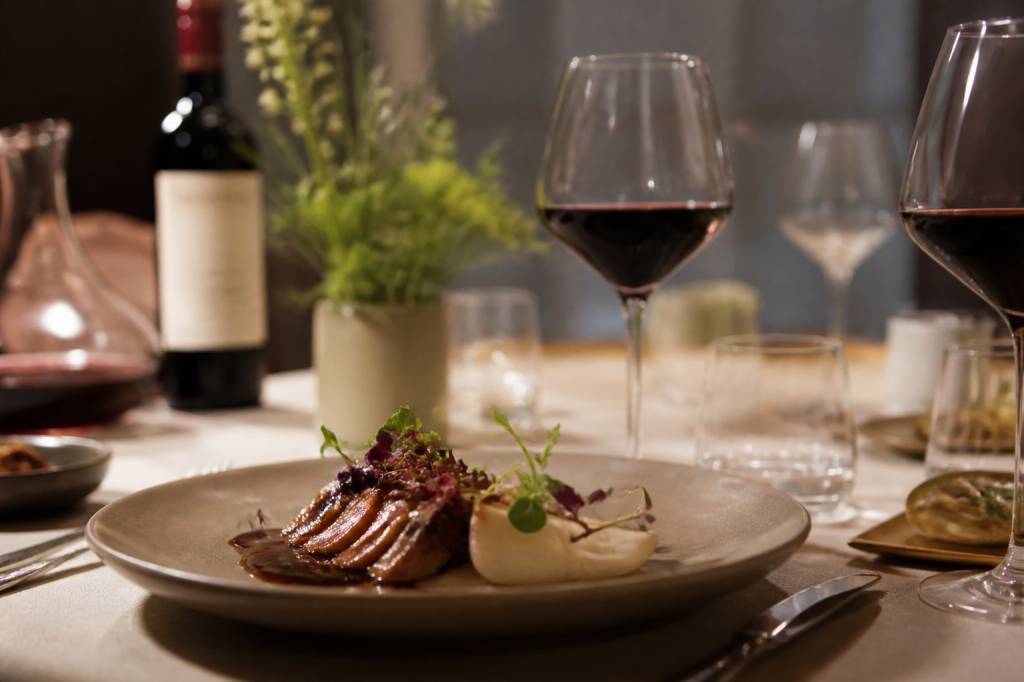
Why fine wine matters in a tasting menu
A tasting menu is not just a sequence of small plates. It is a controlled progression of texture, intensity, temperature, and aromatic build-up. Wine, if chosen properly, should do the same job. It should sharpen one course, soften another, and occasionally create a deliberate friction that makes both food and wine more interesting. That is the real point of pairing fine wines with elegant tasting menus: not showing off bottle prices, but preserving precision across several dishes.
At this level, “good enough” pairing is rarely good enough. A wine with too much oak can flatten a delicate shellfish course. A high-acid white can rescue a rich sauce. A mature red with softened tannins can make game feel almost silken. The menu is a moving target, and the wine list needs to be built like a sequence, not a collection of trophies.
Too often, restaurants overcomplicate this. They reach for prestige without structure, or for structure without pleasure. The best pairings do both. They are technically sound and immediately enjoyable. That balance is harder to achieve than it looks.
The three rules that keep pairings coherent
Before naming bottles, it is worth setting out the mechanics. Elegant tasting menus usually fail when one of three things happens: intensity is mismatched, acidity is ignored, or texture is left out of the discussion. Wine and food pairings are not just about flavour; they are about weight, pressure, and persistence.
- Match intensity to intensity. A subtle dish will disappear beside a muscular wine.
- Respect acidity. Without enough acidity, a wine can feel dull next to a dish with rich sauce, beurre blanc, or cream.
- Think about texture. Tannins, lees ageing, carbonation, and oak all change how a wine behaves in the mouth.
These are not abstract principles. In practice, they decide whether a pairing feels integrated or awkward. And awkward, in a fine dining setting, is rarely forgiven.
Champagne and the opening course
If a tasting menu begins with refined amuse-bouches, Champagne is usually the safest and most intelligent opening move. Not because it is fashionable, but because it is structurally adaptable. The best non-vintage cuvées combine acidity, texture, and low dosage restraint. That combination allows them to handle caviar, raw fish, shellfish, crisp vegetables, and even lightly fried elements.
For a menu opening with oysters, sea herbs, or tart citrus accents, a Blanc de Blancs from the Côte des Blancs can be superb. Chardonnay-driven Champagne brings linear acidity and saline precision, which echoes maritime flavours without overwhelming them. If the first course is richer—say, smoked eel, brioche, or a crab tartlet—a more vinous Champagne with some reserve wine and a slightly broader palate is often better.
A useful rule: the more delicate the opening dish, the less dosage and oak you want in the wine. The goal is lift, not weight. No one wants a buttery Chardonnay impersonating a flotation device.
White Burgundy for precision and texture
When the menu moves into scallops, lobster, turbot, or poultry with cream-based sauces, white Burgundy remains one of the most reliable fine-wine pairings in the world. But the key is choosing the right style. A restrained Meursault, Puligny-Montrachet, or Chassagne-Montrachet with measured oak can complement the richness of the dish without dragging it into heaviness.
Chardonnay from Burgundy works because it often has three qualities that tasting menus demand: clarity, textural depth, and enough acidity to keep the palate alive. In a course built around roasted langoustine with shellfish bisque, for example, the wine should have enough body to stand beside the sauce, but enough freshness to avoid fatigue.
I have seen too many menus ruined by over-oaked Chardonnay. The wood is obvious, the fruit is obscured, and the dish suddenly tastes smaller. Fine Burgundy should not behave like a carpentry project. It should feel shaped, not hammered.
For truly elegant pairings, look for wines with subtle reduction, moderate use of new oak, and enough mineral tension to create length. That is where white Burgundy earns its reputation.
Riesling and dishes with acidity, spice, or sweetness
Riesling is one of the most misunderstood wines in high-end food pairing. Too many diners still equate it with sweetness alone, when in reality its best asset is structural precision. High natural acidity, moderate alcohol, and the ability to carry residual sugar without losing shape make Riesling unusually versatile.
For tasting menus, Riesling excels with dishes that combine acidity and aromatic complexity: ceviche, Asian-inspired seafood, herb-rich preparations, or foie gras with fruit. A dry Riesling from the Mosel, Rheingau, or Alsace can work brilliantly when the kitchen uses ginger, yuzu, green mango, or light chilli. If there is a touch of sweetness in the wine, it can act like a seasoning rather than a dessert cue.
One point that deserves emphasis: sweetness is not the enemy. In the right context, a subtle off-dry Riesling can improve the whole dish by softening heat and amplifying aroma. The trick is to avoid cloying sugar and keep the acid line intact. When Riesling is balanced, it can be one of the most precise tools in the sommelier’s kit.
Pinot Noir for duck, mushrooms, and game
When the menu shifts toward land-based flavours—duck breast, pigeon, mushroom ravioli, venison, quail—Pinot Noir becomes a natural candidate. But again, the style matters more than the grape name. The wine must be refined enough to support the dish, yet structured enough to stand up to protein and umami.
Red Burgundy is the obvious reference point, but not every bottle is suited to a tasting menu. The best choices are those with fragrant red fruit, moderate tannin, and a savoury edge that can interact with mushrooms, truffle, or roast poultry. Too much extraction or new oak can make the wine feel dense and metallic next to delicate preparations.
Pinot Noir’s strength is its ability to create continuity. It can bridge the gap between a lighter fish course and a more substantial meat course if the menu is sequenced intelligently. For example, a course of duck with cherry glaze and smoked beetroot can be transformed by a cool-climate Pinot with bright acidity and fine tannins. The dish gains lift. The wine gains shape. That is what pairing should do.
Fine reds that do not bully the plate
Not every elegant tasting menu needs a full-bodied red. In fact, many do better without one. But when red wine is required, the priority should be elegance, not force. A wine with excessive alcohol, heavy extraction, or obvious sweetness from ripeness can dominate a menu that has spent four courses building finesse.
Depending on the cuisine, several styles can work:
- Garnacha from old vines with freshness and moderate tannin for roast pigeon or lamb.
- Elegant Barolo or Barbaresco with aged tannins for truffle, porcini, or braised veal.
- Cabernet Franc from the Loire for herb-driven lamb or dishes with green pepper and root vegetables.
- Left Bank Bordeaux in mature form for beef or game, provided the tannins have softened.
The important detail is maturity. A young tannic red is rarely the right choice for a long menu. As tannins polymerise over time, the wine becomes more integrated and less abrasive. That is exactly what a tasting menu needs. A mature red can offer complexity without aggression, which is often more valuable than raw power.
Sweet wines and dessert that actually taste like dessert
There is still a bad habit in some restaurants of treating dessert wine as an afterthought. It should not be. A fine menu deserves a final pairing with the same discipline as the first course. The challenge is obvious: dessert is sweet, and wine must be sweeter still to avoid tasting thin or sour.
Sauternes, Barsac, Tokaji Aszú, late-harvest Riesling, and Vouvray Moelleux all have their place, but the choice depends on the dessert structure. A tarte Tatin with caramel and apple may call for botrytised sweetness and enough acidity to cut through butter. A citrus tart might be better with a late-harvest Chenin Blanc that preserves freshness. A blue cheese course, if included, is a natural partner for a wine with both sweetness and acidity, especially Sauternes or Tokaji.
In my experience, the most common mistake is serving a dessert wine that is too light for the dish or too low in acidity to refresh the palate. A dessert pairing should not feel sticky. It should feel complete.
How to build a full pairing sequence without fatigue
A successful tasting menu pairing is not simply a line of impressive bottles. It is a progression that manages palate fatigue. Alcohol, oak, tannin, sweetness, and even effervescence need to be calibrated over the entire meal. If the second course is already intense, the fifth course cannot be even heavier without consequence.
One practical strategy is to alternate between tension and volume. Start with Champagne, move to a taut white, then a richer white or textured amber wine if the kitchen allows it. Introduce red only when the food demands it, and keep the tannins fine. Finish with a sweet wine or fortified style that is rich enough to meet dessert but still lifted by acidity.
Temperature matters too. Whites served too cold lose aromatic detail; reds served too warm become flabby and alcoholic. For tasting menus, precision in service is not optional. It is part of the pairing.
Examples of pairings that work in the real world
Here are a few combinations that consistently perform well in elegant settings:
- Oysters, cucumber, and dill with Blanc de Blancs Champagne.
- Scallops, cauliflower cream, and brown butter with restrained white Burgundy.
- Crab, yuzu, and fennel with dry Riesling from Alsace or the Rheingau.
- Duck breast, cherry, and beetroot with premier cru Pinot Noir.
- Venison, celeriac, and juniper with mature Barolo or structured Bordeaux.
- Goat cheese, pear, and walnut with Chenin Blanc from Vouvray.
- Tarte Tatin with Sauternes or Tokaji Aszú.
These are not rigid prescriptions. They are models. A kitchen with a strong identity will often push you to make more specific choices, and that is a good thing. Pairing should respond to the dish, not the label.
The final measure of a fine pairing
The best wine pairings in a tasting menu do not call attention to themselves for long. They create a moment of clarity, then disappear into the next course with grace. You notice them because the dish seems more defined, or the wine tastes more complete. That is the mark of a successful match.
Fine wine is not about prestige for its own sake. In the context of an elegant tasting menu, it is a precision instrument. Choose bottles with structure, not just reputation. Respect the sequence of the menu. Keep acidity alive, tannins civilised, and sweetness honest. If you do that, the meal will feel coordinated rather than decorated. And in fine dining, that difference is everything.